
Development Cost Statistics show that building modern software has become increasingly expensive, with many web applications now costing anywhere from tens of thousands to hundreds of thousands of dollars to develop. As engineering salaries, operational overhead, and workflow complexity continue rising, AI-native development platforms are beginning to reshape how software teams reduce costs, accelerate iteration cycles, and ship products more efficiently.
 Software development has become dramatically more expensive over the last decade. Between rising engineering salaries, infrastructure complexity, DevOps overhead, QA requirements, and longer release cycles, even relatively small software products can require six-figure budgets before generating revenue.
At the same time, AI-native development platforms are beginning to reshape the economics of building software. Studies now show that developers using generative AI can complete some coding tasks up to twice as fast, while companies adopting AI workflows are reporting major productivity gains across engineering, documentation, testing, and project management workflows.
The result is a major shift in how modern software teams operate. Instead of relying entirely on large engineering departments and fragmented workflows, businesses are increasingly exploring AI-assisted development platforms that can reduce operational friction, accelerate prototyping, iteration cycles, and development, and lower overall development costs.
Key AI Development Cost Statistics
Enterprise web applications often cost $100,000–$500,000+ to build
Senior software engineers commonly earn $120,000–$220,000+ USD annually
Developers using generative AI completed some tasks up to 2x faster
GitHub Copilot users completed coding tasks 55.8% faster
McKinsey found generative AI improved product management productivity by roughly 40%
Atlassian found 68% of developers save more than 10 hours weekly using AI tools
McKinsey estimates generative AI could create up to $4.4 trillion annually in productivity gains
How Much Does Traditional Web App Development Cost?
Modern web application development is significantly more expensive than many founders and businesses initially expect. According to multiple 2026 software development cost estimates, enterprise-grade applications can easily cost between $84,000 and $530,000 or more to build depending on complexity, AI integrations, security requirements, and infrastructure demands.
Even basic to mid-range micro SaaS products with authentication systems, dashboards, payment processing, APIs and cloud hosting integrations can cost roughly $35,000 to $150,000+ to build using traditional development processes.
These costs rise quickly because modern software development typically requires multiple specialized roles, including frontend developers, backend developers, DevOps engineers, QA testers, UI/UX designers, product managers and cloud infrastructure specialists.
According to Glassdoor and Levels.fyi salary estimates, senior software engineers in North America commonly earn between $120,000 and $220,000+ USD annually before factoring in benefits, payroll taxes, software licenses, office overhead, recruiting costs, and infrastructure expenses. At larger enterprise and Big Tech companies, total compensation packages can exceed $300,000 USD per year for experienced engineers.
As projects scale, coordination overhead, management complexity, meetings, and cross-team communication can become just as expensive as the coding itself.
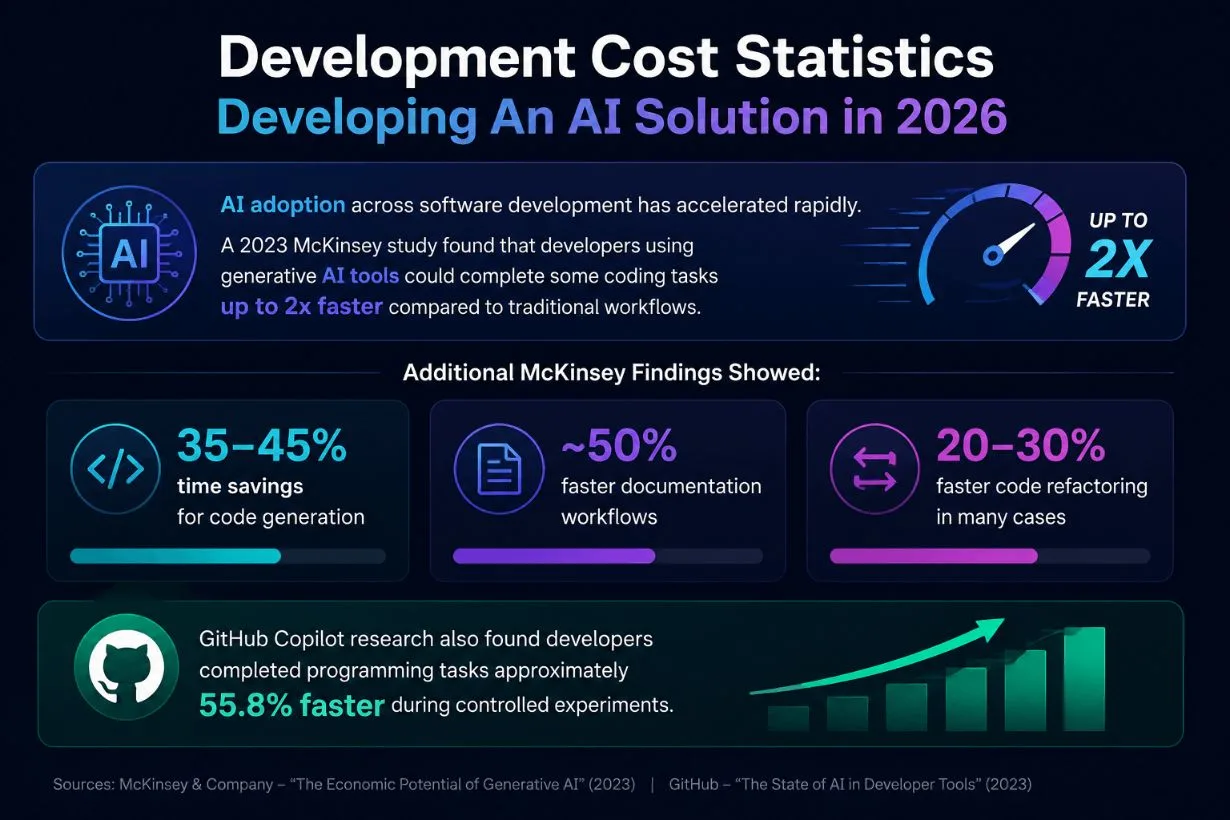
Development Cost Statistics - Developing An AI Solution in 2026
AI adoption across software development has accelerated rapidly over the past two years. A 2023 McKinsey study found that developers using generative AI tools could complete some coding tasks up to 2x faster compared to traditional workflows.
Additional McKinsey findings showed:
35–45% time savings for code generation
roughly 50% faster documentation workflows
20–30% faster code refactoring in many cases
GitHub Copilot research also found developers completed programming tasks approximately 55.8% faster during controlled experiments.
 Meanwhile, AI adoption itself has become mainstream among engineering teams. According to Atlassian’s 2025 State of Developer Experience research, 68% of developers reported saving more than 10 hours per week using AI tools.
On top of that, McKinsey estimates that generative AI could contribute up to $4.4 trillion annually in productivity gains across the global economy over time. These numbers suggest that AI development is no longer experimental. It is increasingly becoming part of the default software development workflow.
The Hidden Costs of Traditional Software Development
One of the biggest hidden expenses in software development is requirement drift, where product requirements, documentation, designs, and implementation slowly fall out of sync as projects evolve.
As engineering teams scale, developers often spend more time clarifying changes, updating tickets, searching for outdated documentation, and coordinating across departments than actually building features.
According to Atlassian, 50% of developers lose more than 10 hours per week to inefficiencies, while knowledge workers spend roughly 25% of their time searching for information instead of executing meaningful work.
Over the course of a year, these fragmented workflows can quietly translate into thousands of lost engineering hours and hundreds of thousands of dollars in wasted productivity for larger software teams.
This is one reason AI-native development platforms like Omniflow are gaining traction. Instead of relying on static documentation and disconnected workflows, Omniflow’s living PRDs help keep requirements, designs, and implementation synchronized throughout the development lifecycle.
By reducing requirement drift and minimizing costly rework cycles, AI-assisted workflows can help teams ship faster, reduce operational overhead, and lower one of the most overlooked costs in software development.
How Omniflow Helps Reduce Development Costs
One of the biggest ways Omniflow helps reduce software development costs is by saving time and accelerating workflows that traditionally consume large amounts of engineering time.
Tasks such as UI generation, boilerplate code creation, documentation, API scaffolding, and workflow automation can often be completed significantly faster using AI-assisted development environments.
This allows teams to prototype ideas more rapidly, shorten MVP development timelines, and validate products before committing to larger engineering budgets.
By centralizing large portions of the product, design, and development workflow into a synchronized AI-native environment, Omniflow can help smaller teams produce significantly more output without the same operational complexity.
McKinsey research found that generative AI improved product management productivity by roughly 40% while also helping accelerate time-to-market. This matters because development bottlenecks often occur outside the actual coding process.
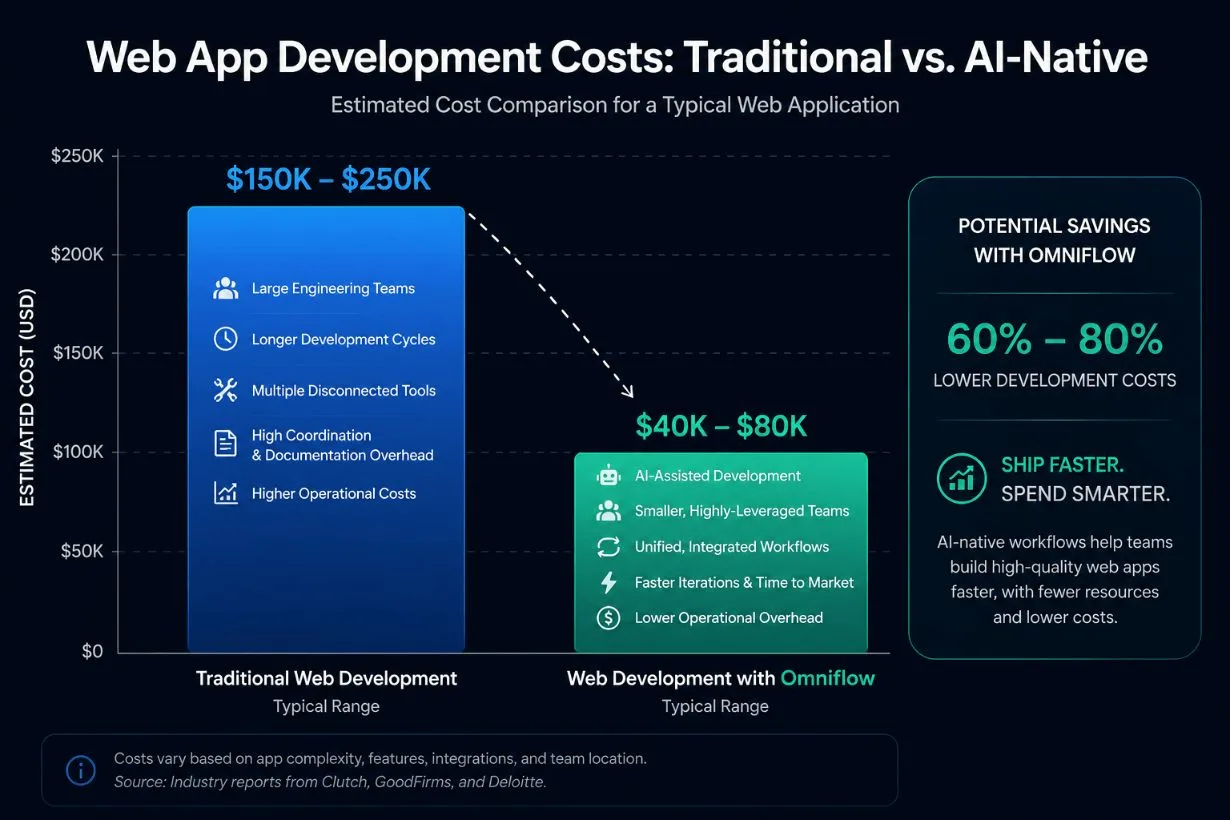 Traditional Development vs AI-Assisted Development
Ready or not, the economics of software development are beginning to shift as AI-native workflows reduce many of the inefficiencies associated with traditional engineering teams.
Historically, software companies often relied on large specialized departments working across fragmented systems and long sprint cycles. This model is expensive, with enterprise applications costing anywhere from $100,000 to more than $500,000 to build.
Meanwhile, AI-native no-code and low-code development environments are changing this equation by allowing smaller teams to produce more output with fewer bottlenecks. Developers using generative AI could complete some coding tasks up to 50% faster.
Platforms like Omniflow aim to reduce inefficiencies by centralizing the entire product workflow. By reducing requirement drift, fragmented workflows, and costly rework cycles, AI-native development platforms can help businesses ship software faster while lowering overall development costs.
Conclusion - Building AI Projects Faster & Cheaper Than Ever
The software industry is entering a major shift in how products are built. Instead of relying entirely on large engineering teams, disconnected workflows, and lengthy development cycles, businesses are increasingly adopting AI-native platforms that help teams move faster with fewer operational bottlenecks.
Platforms like Omniflow are designed around this new model of development by combining AI-assisted workflows, synchronized documentation, and living PRDs into a centralized environment built for faster execution.
👉 If your team is looking to reduce development costs, improve shipping velocity, and streamline the software development lifecycle... Try Omniflow today to see how AI-native development workflows can help your business build more efficiently.
FAQ - The Upfront Costs & Ongoing Costs Of Traditional Web Development
How much do AI development projects typically cost?
AI development projects can vary dramatically in cost depending on project complexity, infrastructure requirements, and the type of AI systems being built. Simple AI adoption initiatives using pre trained models may cost only a few thousand dollars, while advanced AI systems and enterprise-grade artificial intelligence platforms can cost hundreds of thousands of dollars to develop and maintain.
What are the biggest cost drivers in AI development?
Some of the biggest cost drivers in AI development include cloud infrastructure, skilled AI engineers, data preparation, model training, implementation costs, ongoing costs, and maintaining AI systems over time. Complex projects involving computer vision systems, custom AI solutions, or specialized AI platforms often require significantly larger budgets due to higher computational demands and integration complexity.
Why is project complexity important when estimating AI costs?
Project complexity plays a major role in AI cost estimation because more advanced workflows often require larger datasets, more sophisticated models, increased testing, and longer development cycles. AI systems designed for enterprise environments or existing systems integrations typically involve more implementation costs than smaller standalone AI applications.
Are pre trained AI models cheaper than custom AI development?
In many cases, pre trained AI models can dramatically reduce the cost of AI development because businesses do not need to build models entirely from scratch. However, organizations may still incur costs related to customization, deployment, cloud infrastructure, and maintaining AI systems after launch.
What are the ongoing costs associated with AI systems?
Many businesses underestimate the ongoing costs of AI adoption. Beyond initial implementation costs, companies may need to budget for cloud infrastructure, model retraining, monitoring, compliance, API usage, data storage, security, and ongoing support from skilled AI engineers. These recurring operational expenses can become significant as AI systems scale.
How can AI-native platforms help reduce artificial intelligence costs?
AI-native development platforms like Omniflow help reduce artificial intelligence cost by streamlining workflows, reducing requirement drift, accelerating implementation, and minimizing operational overhead. Instead of relying on fragmented workflows and disconnected tooling, AI platforms centralize development processes into more efficient environments that help teams build and deploy AI solutions faster.
Is AI adoption only about technology?
No. Successful AI adoption is not just technology — it also involves workflow optimization, collaboration, documentation, operational efficiency, and long-term scalability. Many companies discover that reducing hidden coordination costs and workflow fragmentation can create just as much value as the AI models themselves.
Why are implementation costs often underestimated in AI projects?
Implementation costs are frequently underestimated because businesses focus primarily on model development rather than the full deployment lifecycle. Integrating AI into existing systems, managing data quality issues, configuring cloud infrastructure, and ensuring long-term maintainability can substantially increase the total cost of ownership for AI projects.
Sources
Atlassian. (2025). State of developer experience report 2025. https://www.atlassian.com/blog/developer/developer-experience-report-2025
Atlassian. (2024). How tech leaders can turn AI hype into real team productivity. https://www.atlassian.com/blog/development/how-tech-leaders-can-turn-ai-hype-into-real-team-productivity
GitHub & OpenAI. (2023). The impact of AI on developer productivity: Evidence from GitHub Copilot. arXiv. https://arxiv.org/abs/2302.06590
Glassdoor. (2026). Senior software engineer salaries. Glassdoor. https://www.glassdoor.com/Salaries/senior-software-engineer-salary-SRCH_KO0,24.htm
Levels.fyi. (2026). Software engineer salary data. https://www.levels.fyi/software-engineer/salaries/
OS-System. (2026). How much does it cost to create a web application from scratch? https://os-system.com/blog/how-much-does-it-cost-to-create-a-web-application-from-scratch/
Tech Stack. (2026). Web application development cost guide. https://tech-stack.com/blog/app-development-cost-2026/
GitHub. (2023). Research: Quantifying GitHub Copilot’s impact on developer productivity and happiness. https://github.blog/news-insights/research/research-quantifying-github-copilots-impact-on-developer-productivity-and-happiness/
McKinsey & Company. (2024). Superagency in the workplace: Empowering people to unlock AI’s full potential. https://www.mckinsey.com/capabilities/mckinsey-digital/our-insights/superagency-in-the-workplace-empowering-people-to-unlock-ais-full-potential-at-work
ArXiv. (2025). The hidden maintenance burden of AI-generated software code. arXiv Preprint. https://arxiv.org/abs/2510.10165