
 The real cost of requirement drift
How many hours did your team spend last sprint on work that was caused by requirements changing after the build started? Take a moment to think about it honestly. Not the hours in the kickoff meeting, not the time writing the PRD. The hours spent rebuilding something that was already built. The realignment call ran 90 minutes because design and engineering had two different interpretations of the same spec. The patch job on Tuesday was because a stakeholder reviewed the prototype on Monday and had notes.
Most engineering leads and product managers can't answer that question precisely, and that's exactly the problem. Requirement drift is one of the most consistent drains on team velocity in software development, yet it rarely shows up as a line item in any retrospective. It's the cost that hides inside other costs: "we ran long this sprint," "we hit some complexity," "we needed more alignment time than expected."
This post is an attempt to assign a number to that cost and to explain why the standard fixes keep falling short.
Defining requirement drift and why it's not just a communication problem
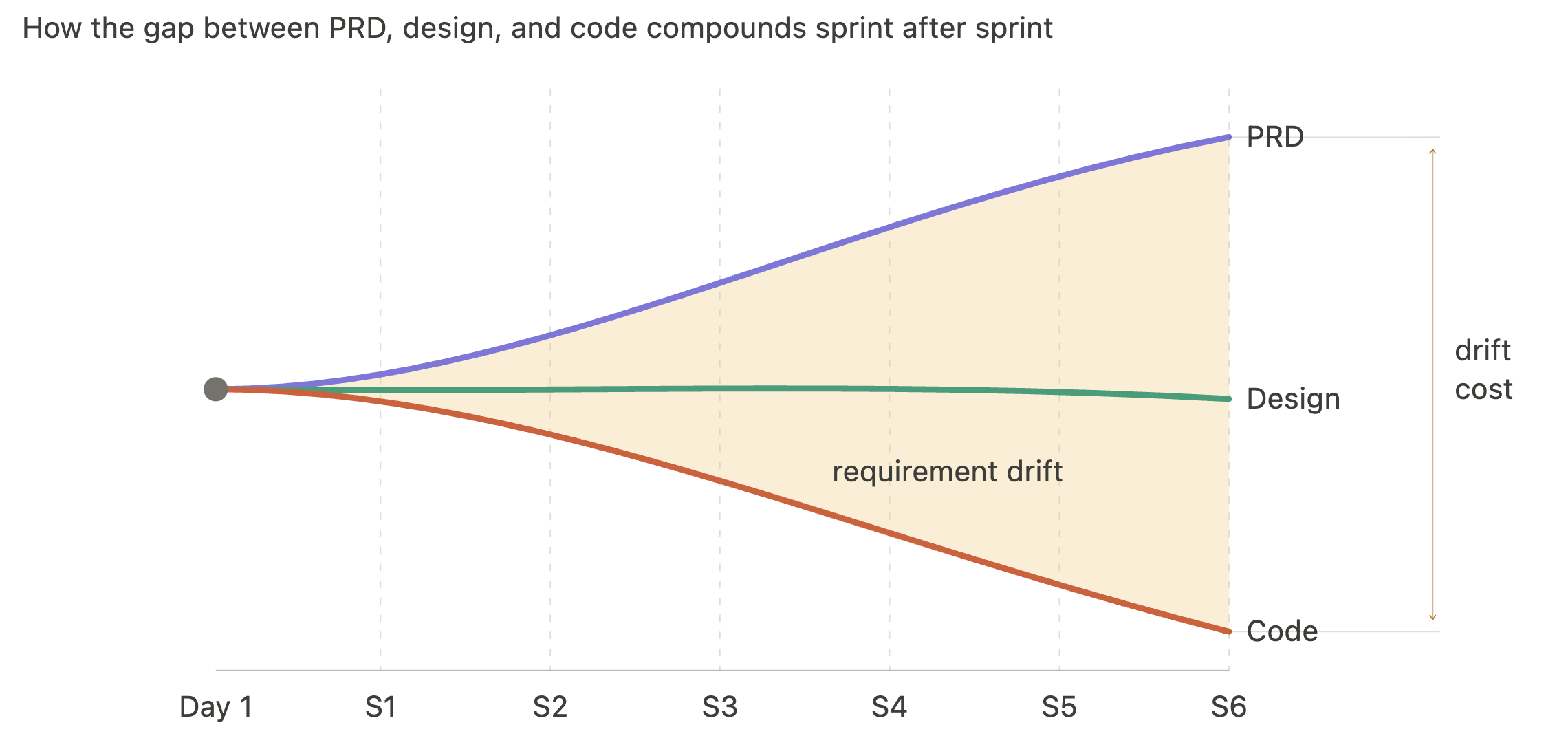
Requirement drift is the gap that opens between what was specified, what was designed, and what was built, and the way that gap compounds over time.
It's worth distinguishing this from scope creep, which is often the first thing people reach for when a sprint goes sideways. Scope creep is intentional: a stakeholder adds a feature, a PM expands the definition of done, a new requirement gets folded in mid-cycle. Scope creep is visible, negotiable, and manageable with a disciplined change-control process.
Requirement drift is different. It isn't intentional. It happens when a designer makes a UI decision that doesn't make it into the spec, when an engineer hits an ambiguous requirement and makes a reasonable call to keep moving, and when a designer makes a UI decision that doesn't make it into the spec. When a stakeholder's feedback during review quietly reshapes a feature's direction without anyone formally updating the source of truth. The spec says one thing, the design says something slightly different, and the codebase reflects a third interpretation that made sense to the engineer in the moment.
This is not a discipline problem. The teams experiencing the most requirement drift are often the ones with the most thorough documentation and the most well-intentioned alignment processes. The root issue is structural: requirements, design, and code live in separate systems with no live connection between them. When one changes, the others don't automatically follow. That gap is where drift lives.
The four points where requirements and code diverge
Drift doesn't happen all at once. It accumulates at specific, predictable moments in the development cycle.
During design
The PRD hands off to design, and the designer starts making decisions. Some of those decisions are purely visual. Others have functional implications: a navigation change that affects user flow. This interaction pattern assumes a piece of data that wasn't in the spec, a layout choice that makes a previously simple requirement significantly more complex to implement. Most of those decisions never make it back into the PRD. The designer is moving fast, the document feels like the past, and updating it isn't part of the workflow.
By the time engineering picks up the design file, the spec and the mockup are already telling slightly different stories.
During build
Ambiguity in requirements is inevitable. No PRD covers every edge case, and when engineers encounter one mid-build, they have two options: stop and ask, or make a reasonable call and keep moving. Under sprint pressure, most teams default to the latter. The engineer's judgment call is often correct in isolation, but it introduces an undocumented deviation that nobody will discover until QA, review, or after launch.
During review
Stakeholder review is where drift accelerates. A founder sees a prototype and adjusts their vision. A sales lead flags a conflict with a customer promise. A PM realizes that the original requirement missed something important. These are legitimate inputs, but they rarely come with a corresponding update to the spec. The feedback lives in a Slack thread or a comment in Figma, engineering picks it up in a follow-up call, and the PRD continues to reflect the original intent while the product quietly becomes something else.
Post-launch
This is the most overlooked stage. Products evolve after launch, sometimes quickly. Features get extended, UX gets revised, and new integrations get added. But the PRD, if it's updated at all, tends to lag months behind. For teams returning to a feature area six months later, the documentation is effectively historical fiction. The real source of truth is the codebase itself, and reading the codebase to understand intent is expensive.
Putting a number on requirement drift
The way to make drift visible is to calculate its time cost and then convert it to money. Here's a straightforward framework any engineering lead or PM can run on their own team.
Step 1: Identify your drift-related time categories
Step 2: Estimate hours per sprint
For a team experiencing moderate drift, conservative estimates often look like this:
Realignment meetings: 3–5 hours per sprint per team
Rework: 4–8 hours per engineer per sprint
Re-prompting / re-briefing: 2–4 hours per sprint
Documentation catch-up: 2–3 hours per sprint
Total conservative estimate: 11–20 hours per sprint across the team
Step 3: Multiply by team cost
Using a blended engineering hourly rate of $100–$150 (a reasonable estimate for a mid-size US-based team):
At 11 hours: $1,100–$1,650 per sprint
At 20 hours: $2,000–$3,000 per sprint
Annualized across 26 two-week sprints: $28,000–$78,000 per year
For larger teams or teams with higher sprint velocity, those numbers scale quickly. And this doesn't account for the indirect costs: delayed launches, slower iteration cycles, and the compounding effect of technical debt introduced every time code is written against an ambiguous or outdated spec.
The data support this. Research from the Project Management Institute has consistently found that poor requirements management is one of the leading causes of project failure, with a significant share of rework traced directly back to incomplete or shifting requirements. IBM research has similarly estimated that fixing a requirements defect post-launch costs between 30 and 100 times more than catching it before development starts.
Most teams are absorbing that cost in silence, sprint after sprint.
Why better documentation alone doesn't fix drift
The natural response to a requirements problem is to write better requirements. More detail in the PRD, cleaner acceptance criteria, and more thorough design specs. It's a reasonable instinct, and it's mostly wrong, because the problem isn't the quality of the documentation. It's that the documentation is static.
A more detailed PRD still requires someone to update it manually when a design decision changes. Cleaner acceptance criteria still have to be communicated, interpreted, and remembered when an engineer hits an edge case at 4 pm on Thursday. The document and the work are separate things, and keeping them in sync is an ongoing manual task that gets deprioritized under sprint pressure every single time.
More alignment meetings run into the same wall. They treat the symptom, not the cause. A 30-minute sync at the start of the sprint doesn't prevent the drift that happens on day six when a stakeholder drops feedback in Slack. More meetings also carry their own cost: they consume exactly the kind of focused time engineers need to build.
Stricter change management processes are closer to the right idea, but often too rigid for fast-moving teams. A formal change request process that takes two days to approve a small scope adjustment doesn't fit the pace of a team doing two-week sprints. Teams end up routing around the process, which leads to undocumented changes and drift by default.
The underlying issue remains the same in each case: requirements, design, and code are stored in separate systems, maintained by separate people, and updated on separate schedules. There is no structural mechanism keeping them in sync. Greater effort within a broken structure yields marginally better outcomes.
What changes when requirements drive code automatically
The structural fix for requirement drift is a workflow in which the PRD isn't a document that gets handed off and forgotten. It's a live source of truth that keeps design and code connected throughout the development cycle.
In practice, this means a few things change. When a requirement is updated, the change propagates to the relevant design and implementation contexts automatically, rather than relying on someone to remember to communicate it. When a design decision diverges from the spec, it gets flagged before it compounds downstream. When an engineer needs to make a judgment call on an ambiguous requirement, there's a mechanism to surface that ambiguity and resolve it in a way that updates the spec rather than leaving an undocumented gap.
The team's energy shifts as a result. Instead of spending sprint time on realignment, the team spends it building. Instead of discovering drift in review, they prevent it during planning. The retrospective conversation moves from "why did we fall short of velocity this sprint" to "what should we build next."
This is the problem Omniflow's sync engine is built to solve. By connecting the PRD, design, and code in a single environment, changes in one layer surface immediately in the others. Drift gets caught early, when it's cheap to fix, rather than late, when it requires rework. The result is a development cycle that moves faster, not because the team is working harder, but because they're working from a single, shared source of truth.
Drift is a tooling problem, not a team problem
If your team is consistently falling short of its sprint velocity targets, it's worth asking how much of that gap is actually requirement drift in disguise. Chances are, re it's more than your retrospectives are capturing.
The good news is that this is solvable, notNot by writing more thorough documentation or scheduling more alignment time, but by changing the structure of how requirements, design, and code relate to each other.
Omniflow was built to make that structural change accessible to any engineering team, without overhauling your entire workflow to get there.
See how it works with your team. https://app.omniflowai.com/