
Full stack developer opportunities are evolving faster than ever—but not for the reasons most people think. It’s not about learning more frameworks or mastering another Java stack. The real shift is happening in how products are built. Today’s full stack engineers are moving away from fragmented workflows and toward unified, AI-powered systems that eliminate complexity and unlock faster, smarter development.
 For years, becoming a full stack developer was seen as the ultimate career move in software development. If you could handle frontend, backend, databases, and deployment, you were valuable. But here’s the uncomfortable truth most full stack engineers are starting to realize: The role hasn’t gotten simpler. It’s gotten fragmented.
People often wonder if AI is going to replace software engineers. We don't think so. The real problem is simply that today’s full stack web developer isn’t just building products. They’re juggling disconnected systems, chasing outdated requirements, and constantly fixing things that broke somewhere else in the stack.
And that’s exactly where the biggest opportunity is emerging. Omniflow now makes web development easier than ever. No more using multiple tools or platforms. No more endless hours coding. No more requirement drift after hand-off.
The Core Problem with Full Stack Development Today
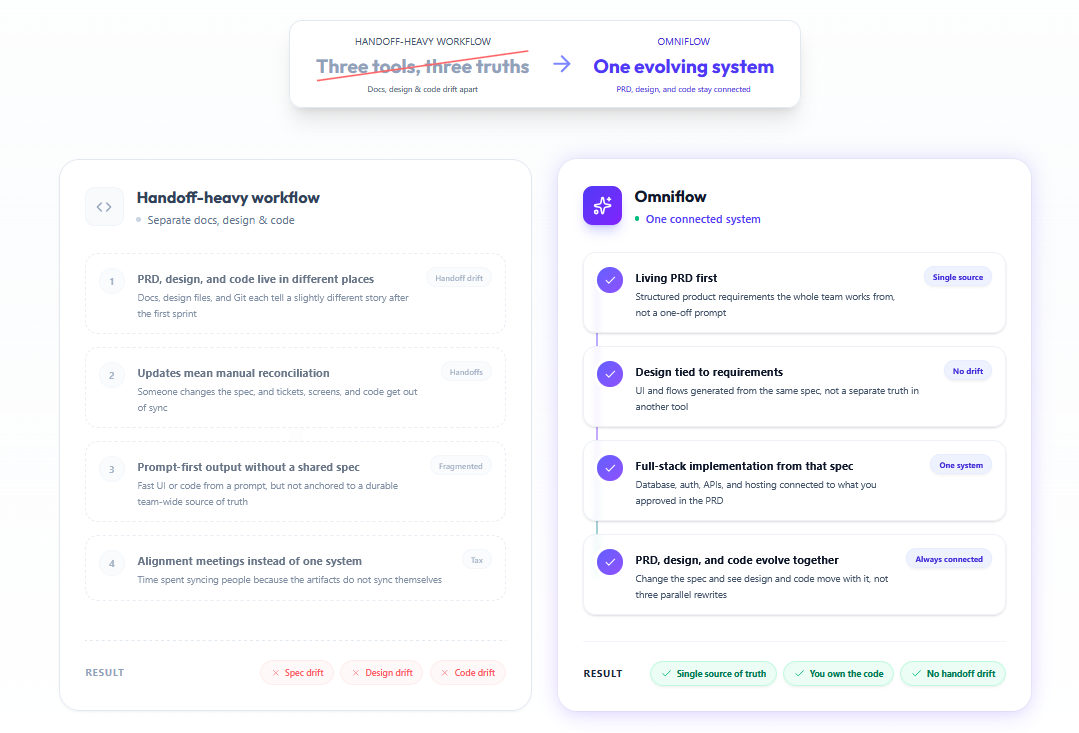
In traditional software development, teams operate across disconnected layers:
Product requirements live in PRDs
UI/UX designs live in design tools
Programming languages lives in repositories
Infrastructure lives somewhere else entirely
The result is constant requirement drift, endless rebuilds after small changes, and multiple “sources of truth” that never fully align, especially as projects evolve. Even the most experienced full stack software engineers spend a significant portion of their time not building, but reconciling.
No matter what type of role you plat in full stack web development, you know how even a simple update to a feature can trigger a cascade of manual changes across design, backend logic, and deployment pipelines. It’s often inefficient, error-prone, and slows down innovation. This is where a new category is emerging.
Introducing Omniflow - The Living Product Platform
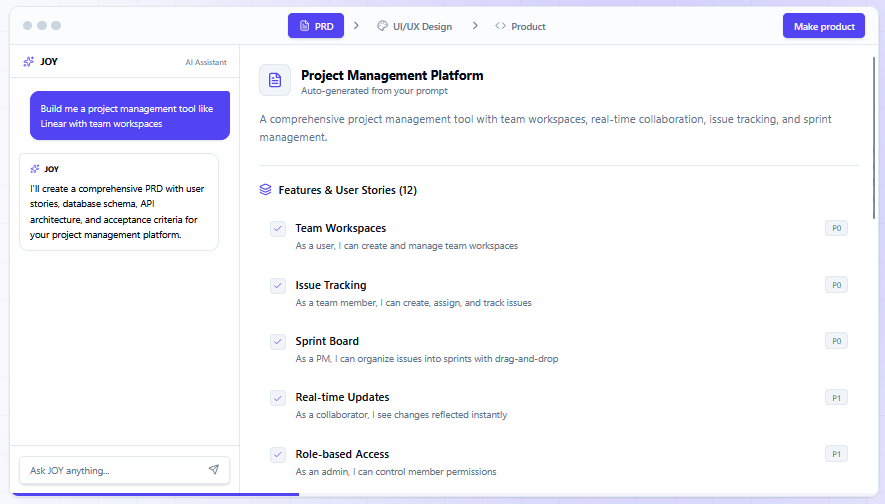
Omniflow is redefining and improving full stack development with what we call a living product platform. Instead of treating PRDs, design, and code as separate artifacts, Omniflow turns them into one unified, dynamic system.
When requirements change, everything including product requirements (PRDs), UI and design, backend development and deployment-ready infrastructure, are updated automatically. This new flow means that, even as project evolve, there are no rebuilds, no drift and no fragmentation. Just one living system that becomes more efficient and aligned with your project goals as things change.
 Why This Changes Everything for Full Stack Engineers
For anyone in computer science, web development, or software development, this shift is massive. Now, instead of spending time syncing systems, developers can focus on what actually matters, such as building intuitive features, improving user experience, and iterating faster. Omniflow is unlocking a new wave of full stack developer opportunities, where developers are no longer bottlenecked by tooling, but amplified by it.
Omniflow's Key Features Powering This Shift
Full stack development has traditionally been defined by complexity, multiple tools, disconnected workflows, and constant manual updates across PRDs, design, and code. Omniflow’s living product platform flips that model on its head by bringing everything into one unified system. The result is faster iteration, fewer errors, and a development process where every part of your product stays perfectly in sync automatically.
Here's what makes Omniflow different from other low-code and no-code development platforms.
Living PRDs (No More Requirement Drift)
Traditional PRDs are static. They become outdated the moment development begins. Omniflow introduces living PRDs, where requirement documents stay in sync with your product at all times. As your application evolves, your requirements evolve with it.
Generative AI Chat for Development
Instead of manually wiring features together, developers can use Omniflow's AI-driven chat to modify features, update logic, trigger workflows, and navigate the system. This dramatically reduces friction in full stack development, especially for complex applications.
Visual Editor for UI Development
Frontend development is often a bottleneck—especially when translating designs into production-ready code. Omniflow’s Visual Editor allows developers to work in a WYSIWYG-style interface while maintaining real, functional code underneath. This bridges the gap between design and engineering.
No-Code / Low-Code Flexibility
Not every feature needs to be hand-coded from scratch. Omniflow blends traditional development with no-code/low-code functionality, allowing teams to move faster on simple features, maintain full control over complex systems, and reduce repetitive engineering work.
Production-Ready from Day One
One of the biggest pain points in web apps and software development is deployment. Omniflow removes that entirely with built-in authentication, integrated knowledge bases, and instant deployment. This means no stitching together third-party tools and no infrastructure headaches.
 How Omniflow Compares to Other Platforms
We admit that Omniflow is often compared to other AI platforms like Lovable and Base44. And while many of these AI development tools promise speed, they still rely on fragmented systems behind the scenes. Omniflow is different because it eliminates fragmentation entirely. It’s not just faster, it’s fundamentally more aligned. See our full breakdown of the best AI development platformsto learn more about how Omniflow is different.
The Future of Full Stack Developer Opportunities
Full stack developer jobs aren’t going away. But it is evolving. Instead of managing complexity, developers can now orchestrate intelligent systems, build faster with fewer constraints, and focus on product innovation instead of infrastructure.
Platforms like Omniflow are leading this shift by turning development into a continuous, living process. And for developers who embrace it early, the opportunity is clear... they'll spend less time maintaining systems and more time building what actually matters.
Ready to streamline your operation, save time, and unlock new growth opportunities? Sign up and start building with Omniflow today and turn AI automation into your biggest advantage.
Frequently Asked Questions About Full Stack Development and Omniflow
What is a full stack developer?
A full stack developer is a software engineer who works across both the frontend and backend of an application. This includes user interfaces, database management systems, APIs, and deployment infrastructure. In modern full stack development, developers are often expected to manage multiple tools and systems simultaneously.
Why is full stack development becoming more complex?
Full stack development has become more complex due to fragmented workflows. Requirements, design, code, and infrastructure are often managed in separate tools, leading to misalignment, constant updates, and requirement drift. This forces full stack software engineers to spend more time maintaining systems instead of building products.
What is a living product platform?
A living product platform is a new approach to software development where product requirements, design, and code exist in one unified system. Instead of being static, everything updates in real time as changes are made. Platforms like Omniflow eliminate multiple sources of truth and keep your entire product in sync automatically.
How does Omniflow improve full stack development?
Omniflow improves full stack web development by combining PRDs, UI design, backend logic, and deployment into a single system. Features like living PRDs, generative AI chat, and a visual editor reduce manual work, eliminate requirement drift, and allow developers to iterate faster without rebuilding entire systems.
Is Omniflow a no-code or low-code platform?
Omniflow is both a no-code/low-code platform and a full development environment. It allows developers to quickly build features without writing code when appropriate, while still giving full control over complex systems. This makes it ideal for both experienced full stack engineers and teams looking to move faster.
Can full stack developers be replaced by AI?
AI is not replacing full stack developers, but it is changing how they work. Tools like Omniflow enhance productivity by automating repetitive tasks and simplifying workflows. This allows developers to focus more on building features, improving user experience, and solving complex problems.
What are the benefits of using a living PRD?
A living PRD stays automatically updated as your product evolves. This eliminates outdated documentation, reduces miscommunication between teams, and ensures that development always aligns with current requirements. It’s a major upgrade from traditional static PRDs.
How does Omniflow compare to other AI development platforms?
Unlike many AI tools that still rely on separate systems, Omniflow unifies everything into a single platform. This eliminates fragmentation, reduces errors, and creates a more efficient development workflow compared to traditional and AI-assisted tools.
What are the future opportunities for full stack developers?
The future of full stack developer opportunities lies in working with integrated, AI-powered platforms. Instead of managing complexity, developers will focus on building smarter applications, iterating faster, and leveraging tools that keep systems aligned automatically.