
Most small businesses don’t have a time problem, they have a systems problem. Owners and teams are stuck handling repetitive tasks that eat up hours every week and slow down growth. The right AI automation ideas can eliminate that bottleneck by streamlining operations, reducing manual work, and freeing up time to focus on revenue-generating activities. In this guide, we’ll break down 5 practical, real-world automations you can implement quickly, no hype, just solutions that actually save time and make money.
 Running a small business today is harder than ever. Costs are rising. Competition is global. Customers expect instant responses, personalized experiences, and seamless service, even from companies with just a handful of employees.
And here’s the reality: Most small business owners aren’t losing because they lack ideas. They’re losing because they’re overwhelmed. They’re stuck doing customer support, marketing, admin work, data analysis, and other daily operations, and more often than not, they're doing it all manually.
That’s where the adoption of AI and automation becomes a game-changer. Not as hype. Not as theory. But as a practical way to remove bottlenecks, improve operational efficiency, and scale without hiring additional workers.
What Is AI Automation For Small Business Processes?
AI automation is the process of using artificial intelligence to handle repetitive tasks, make decisions, and execute complex tasks or workflows automatically, without constant human input. Unlike basic automation (like scheduling posts or sending emails), AI intellgient automation can understand inputs (text, data, customer questions), make decisions based on logic or context, trigger actions across tools and systems
Just like an employee, automation can be made to follows rules, to think, adapt, and execute. And it's exactly where platforms like Omniflow come in. Instead of stitching together 10 tools, hiring developers, or writing complex scripts… You can build now AI-powered workflows, apps, and tools in one place, using natural language, AI integrations, and intelligent chat agents.
Why AI Automation Matters for Small Businesses
For large companies, automation is about efficiency. For small businesses, it’s about survival and growth. AI systems allow you to replace hours of manual work with minutes, operate like a larger team without hiring, make faster, data-driven decisions, build new revenue streams to help you grow (not just cut costs).
The biggest shift, however, is that small businesses can now build internal tools and even SaaS products, without traditional development.
5 AI Automation Ideas Small Businesses Can Build with Omniflow
These aren’t theoretical ideas. These are practical, buildable systems that small business owners can create and deploy right now thanks to Omniflow. AI automation refers to any type of automation tools that can take care of routine tasks. Let's take a look and find out how small today's founders can automated a range of small business processes.
#1 - AI Agent Customer Support (24/7 Without Hiring Staff)
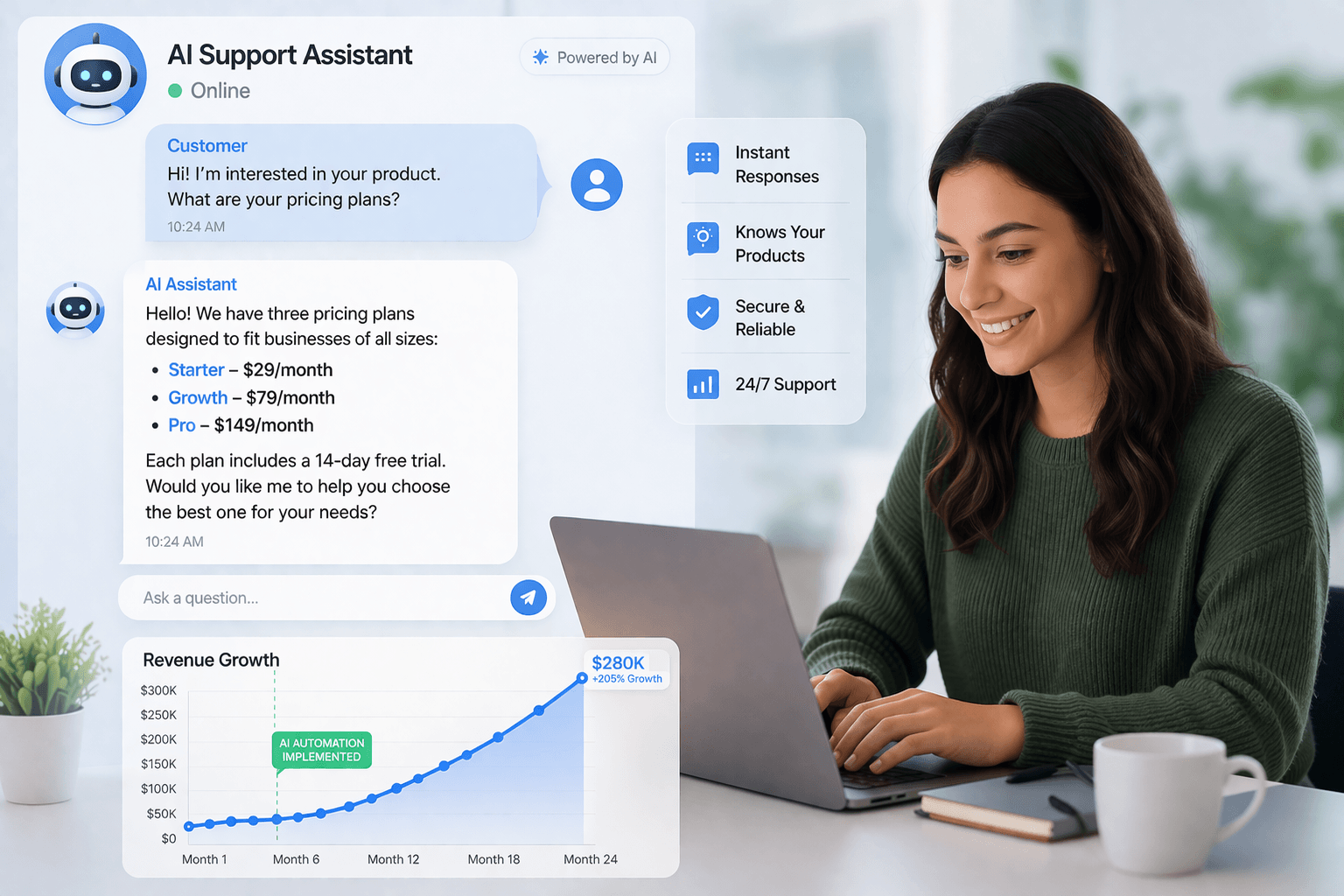
Customer support is one of the biggest time drains for small businesses. Answering the same questions about order status, pricing, services, and other frequently asked questions... repeatedly. Instead of hiring support staff, you can build a generative AI-powered support assistant.
With Omniflow, you can create robotic process automation and AI models that understands customer questions in natural language, pulls answers from your knowledge base or website, responds instantly via chat, email, or integrations, escalates complex issues when needed.
The result is faster response times, lower support costs, and better customer experience. And most importantly, you get your time back.
 #2 - AI Market Research & Competitor Analysis Tool
Most small businesses don’t do proper market research. Not because it’s unimportant, but because it’s time-consuming and other business operations take precedence. AI automation changes that completely. With Omniflow, you can build a tool that analyzes competitors automatically, identifies pricing trends, extracts customer pain points from reviews or other sources, and summarizes market opportunities.
Instead of a ton of manual work, market research becomes a repeatable workflow, where you simply input a niche, machine learning gathers data, and then outputs insight. Instead of guessing, you’re now making decisions based on real data, which would make this tool especially powerful for launching new products, adjusting pricing, and finding opportunities and gaps in the market.
#3 - AI-Powered Automation For Digital Marketing
Marketing is one of the hardest business automation areas for small businesses to scale. Content creation, social posts, emails, ad copy... it’s endless. But with AI automation, you can build a self-running marketing engine.
For example, using Omniflow you could build an automated system that could generate blog posts, emails, and social content, repurpose content across platforms, analyze performance data, adjust messaging based on results.
Instead of wasting time thinking: “what should I post today?” You now have a system that continuously creates and optimizes content, which turns your small business marketing from a task into a non-stop content machine.
#4 - Automated Accounting & Financial Insights Tool
Most small business owners hate accounting. But more importantly, they lack real-time financial insight and a lot of their financial data gets lost in unstructured data piles. AI automation can transform this, by allowing you to build a tool that categorizes expenses automatically, tracks revenue and cash flow, flags unusual transactions, and generates financial summaries, reports and other predictive analytics.
With Omniflow, this can integrate with your existing systems and create a live financial dashboard powered by AI. Instead of reacting to fiscal problems late, you see issues early, make smarter financial decisions, and stay in control of your business.
#5 - Build Artificial Intelligence Tools You Can Sell (New Revenue Stream)
This is where things get really interesting. AI automation isn’t just about saving time, it can also help you create entirely new income streams. Small businesses can now build niche AI tools for their industry, internal tools turned into SaaS, and all sorts of client-facing AI solutions.
For example, you might build:
A real estate lead analysis tool
A fitness coaching AI assistant
A local business marketing generator
But it's not just about AI automation... With Omniflow, you can build the tool, define your workflows, create easy-to-use UI experiences with our Visual Editor, and launch without any sort of traditional development. This turns your business from a service provider into a product + service hybrid, which unlocks scalability like never before.
 Why Omniflow Is Built for
Most no-code or low-code tools solve one small piece of the puzzle. Omniflow is different. It allows you to build full AI-powered workflows, connect multiple systems together, create tools, not just outputs, and automate decision-making, not just perform simple tasks.
Instead of using AI, you’re now building with AI. And that’s the shift small businesses need.
Final Thoughts: AI and Automation Is the New Competitive Edge
The gap between businesses today is no longer defined by budget, team size, or even experience. It’s now defined by systems. Small businesses that embrace AI automation are able to move faster, operate leaner, and scale smarter without constantly increasing overhead.
Instead of getting stuck in day-to-day tasks, they build workflows that run in the background, freeing up time to focus on growth, strategy, and revenue.
The opportunity right now is simple: start building systems that work for you.
If you’re ready to streamline your operations, save time, and unlock new growth opportunities, sign up and start building with Omniflow today and turn AI automation into your biggest advantage.
FAQ: AI Automation for Small Businesses
What is AI automation in simple terms?
AI automation uses artificial intelligence to handle tasks, make decisions, and run workflows automatically, reducing the need for manual work.
How can small businesses use AI automation?
Small businesses can use AI automation to manage customer support, create marketing content, analyze data, track finances, and even build tools or apps that generate revenue.
Is AI automation expensive to implement?
Not anymore. Platforms like Omniflow allow small businesses to build AI-powered tools and workflows without hiring developers, making it far more affordable than traditional software development.
Do I need coding skills to use AI automation tools like Omniflow?
No. Many modern platforms are designed for non-technical users, allowing you to build workflows and tools using natural language, visual builders, and pre-built integrations.
What are the biggest benefits of AI automation for small businesses?
The biggest benefits include saving time, reducing costs, improving decision-making, scaling operations, and creating new revenue opportunities.
Can AI automation replace employees?
AI technologies are best used to perform tasks that are repetitive and time-consuming tasks, not replace people entirely. It allows small teams to focus on higher-value work like strategy, sales, and customer relationships.
How quickly can a small business implement AI automation?
Simple workflows can be built in hours or days, while more advanced systems may take longer depending on complexity. The barrier to entry is significantly lower than traditional software development.
What types of tasks should be automated first?
Start with repetitive, time-consuming tasks like customer inquiries, content creation, data entry, and reporting... These deliver the fastest ROI.
Can AI automation help generate revenue, not just save time?
Yes. Small businesses can build AI-powered tools, products, or services that can be sold to customers, turning automation into a new income stream.
Why use Omniflow instead of multiple AI tools?
Omniflow allows you to build complete complex workflows and tools in one place, instead of juggling multiple platforms. This makes automation more scalable, flexible, and easier to manage.