
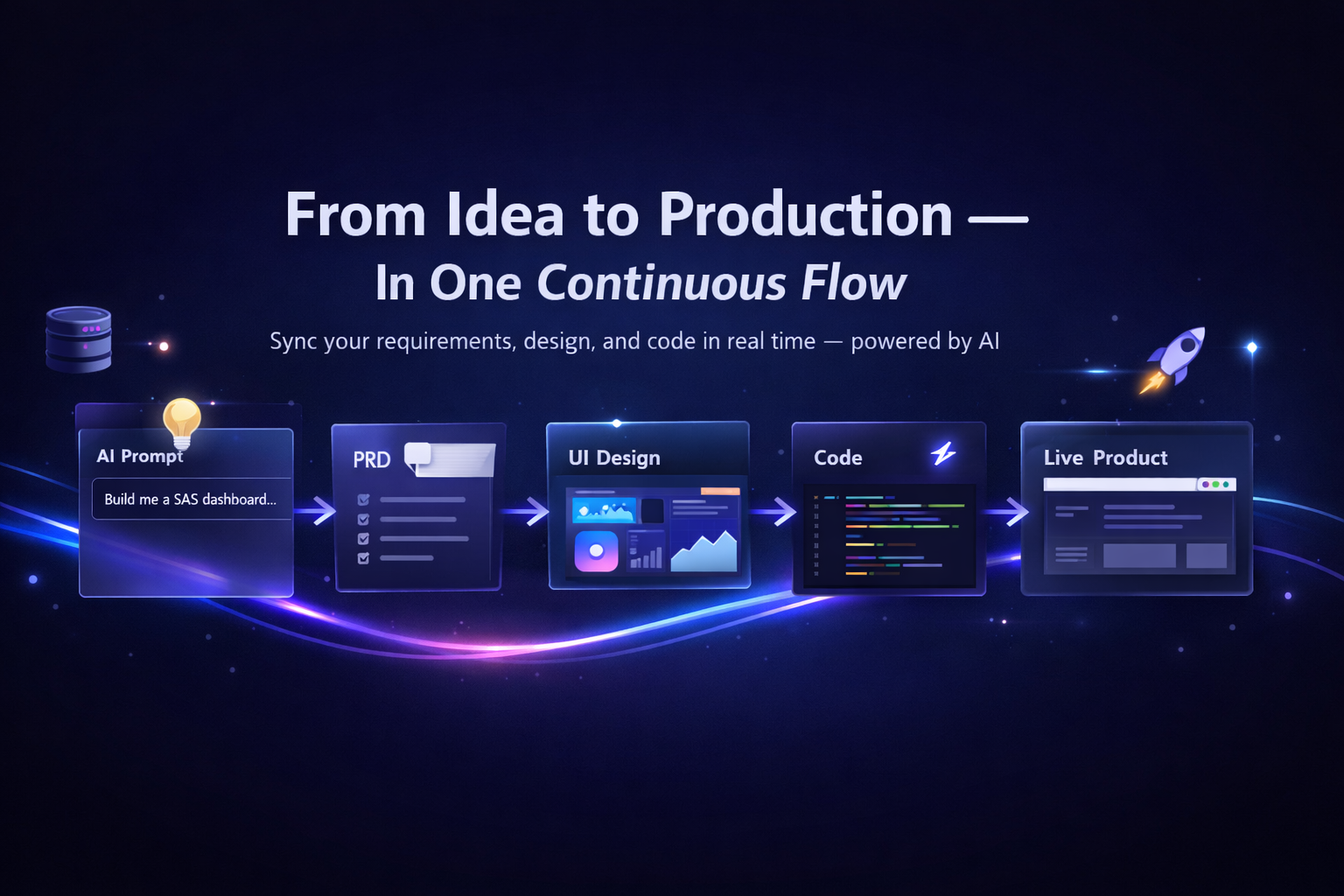
 Every engineering lead eventually has the same conversation with their VP or founder. Ship faster. The team is talented, the backlog is real, and the pressure is reasonable. The problem is that when you actually sit down to trace where your senior engineers' hours go, a significant portion of each sprint has nothing to do with the product decisions that make the company worth building.
That's not a people problem. It's a structural one. And more engineering leads at growth-stage companies are finding that the right AI tooling, specifically tooling built around requirements rather than prompts, is the most practical way to reclaim that capacity.
This post looks at where the overhead actually comes from, why most AI code tools don't solve it, and what a different approach looks like in practice.
What your engineers are spending time on that isn't product logic
Before reaching for a solution, it helps to name the problem accurately. Engineering overhead isn't one thing. It shows up in four distinct categories, and most teams are carrying all four simultaneously.
Scaffolding and boilerplate. Every new feature or service starts with setup work: project structure, configuration files, database schemas, environment variables, and build tooling. A senior engineer can do this quickly, but quickly still means hours, and it happens constantly across a growing codebase.
Infrastructure provisioning. Auth, deployment pipelines, API layer setup, cloud configuration. These aren't glamorous, they're load-bearing. And they require enough expertise that they tend to fall on the people who already have the most on their plates.
Realigning code with changing requirements. This one is underestimated. Product requirements change. They should change. But every time a spec shifts, there's a ripple through the codebase. Engineers track down where assumptions were baked in, patch the affected areas, and try to avoid introducing new inconsistencies. In teams without a clean source of truth, this is where much of the invisible time goes.
Debugging drift between spec and implementation. Related but distinct. Over time, what's in the documentation and what's in the code gradually diverge. When something breaks, the debugging process isn't just "fix the bug," it's also "figure out what we actually intended here."
Cortex's 2024 State of Developer Productivity report found that most engineering leaders estimate between 5 and 15 hours per developer per week are lost to unproductive work that could be automated, optimized, or eliminated. Only 10% said their teams lost fewer than 3 hours. Research from Swarmia suggests the target should be roughly 60% of sprint capacity going to new feature development, with the rest split between maintenance and productivity improvements. Most growth-stage teams are well short of that.
The exact number matters less than recognizing which bucket your team is in. If your seniors are shipping slower than headcount should predict, overhead is usually the explanation.
Why do vibe coding tools shift the problem instead of solving it
Engineering leads are right to be skeptical of AI code generators. The skepticism is earned.
The current generation of prompt-driven coding tools works roughly like this: you describe what you want, the tool generates a codebase, and you start building from there. It feels fast, and for early prototypes, it sometimes is. The problems emerge later.
When requirements change, and they always do, you're back at the prompt. You describe the new direction, the tool generates updated code, and you apply it on top of what's already there. Over several iterations, you accumulate patches on patches. The codebase that felt clean on day one starts to look like something no one fully owns. A December 2025 arXiv paper on vibe coding described this directly: the seamless code generation flow leads to the accumulation of technical debt through architectural inconsistencies, security vulnerabilities, and increased maintenance overhead.
There's also the stack problem. Many AI generation tools output code in configurations that don't match how your team actually builds. When you need to debug something, extend something, or bring a new engineer up to speed, you're working in someone else's conventions rather than your own.
Production-readiness is another gap.A 2024 GitClear analysis found that AI-generated code has a 41% higher churn rate than human-written code, driven by a tendency to produce syntactically correct code that overlooks architectural context. Tools like GitHub Copilot and Cursor excel at boilerplate and autocomplete, but even their proponents acknowledge they handle the happy path better than the edge cases that matter in production.
The cumulative result is that you've traded one kind of overhead for another. Less time on initial setup, more time on maintenance, debugging, and managing technical debt that wasn't there before. For engineering leads who care about code quality and team ownership, that's not a trade worth making.
What changes when code is generated from approved requirements
The alternative is a different architectural premise: code should generate from requirements, not from prompts.
Here's what that means in practice. Instead of describing what you want in a chat interface and receiving code, the process starts with requirements that your team has reviewed and approved. The generated code is traceable to those requirements. Every file, every function, every configuration choice has a source in the spec. When a requirement changes, the codebase updates from the same source of truth rather than through a one-off patch.
For engineering leads, this changes the quality conversation. You're not asking "did the AI get it right?" You're working from the same approved requirements your team would use anyway, and the generated output reflects them directly. Reviewing code becomes faster because the logic has a clear reference point.
The stack matters too. When the output is standard Next.js and TypeScript with full GitHub sync, your team isn't inheriting something alien. They can read it, modify it, extend it, and own it. There's no proprietary layer between your engineers and the codebase.
What makes the requirements-driven approach particularly valuable for growth-stage teams is that it generates the full stack as a coherent system. Database, auth, APIs, and deployment are produced together, aligned with the same spec, rather than assembled from separate decisions made at different times by different people. That coherence is what makes the output feel like something a senior engineer built rather than something that was stitched together.
When requirements evolve, which is not a failure, it's just product development; the update flows from the source rather than accumulating as a layer of patches. Technical debt doesn't compound in the same way because there's always a clean reference for what the codebase is supposed to be doing.LeadDev's 2025 Engineering Performance Report, drawing on data from 500 engineering leaders, found that teams are moving away from output-based metrics toward quality-focused ones. A requirements-first approach is naturally aligned with that shift.
How a CTO at Arrowster cut 30 to 40% of his team's overhead
Arif Khan, CTO at Arrowster, ran into the overhead problem in a form most engineering leads will recognize. His team was capable and motivated, but a meaningful portion of each sprint was going to work that wasn't advancing the product. Set up, alignment work, and keeping the implementation in sync with requirements that had shifted. Senior engineering time was being spent on things that weren't the hard problem.
Before adopting Omniflow, Arrowster's workflow looked like that at most growth-stage companies. Requirements lived in one place, code lived in another, and keeping them aligned was a manual, ongoing effort. When specs changed, engineers tracked down the implications and patched accordingly. It worked, but it was slow, and it created the kind of diffuse technical debt that's hard to measure and harder to pay down.
With Omniflow, the workflow changed at the foundation. Requirements became the source of truth that code was generated from, not a document that code was supposed to eventually reflect. The output landed directly in GitHub in standard Next.js and TypeScript, meaning Arrowster's engineers could work with it immediately in their existing environment without adopting new conventions or learning a proprietary system.
When requirements are updated, the codebase is updated from the same source. No one-off patches, no drift between spec and implementation.
The result Arif cites is a 30 to 40 percent reduction in sprint overhead. In his words: "Omniflow has drastically reduced the time our developers spend on boilerplate tasks, cutting overhead by 30 to 40 percent. This has freed them up to focus on what truly matters, building innovative features and solving complex problems."
For an engineering lead trying to understand what that means concretely, it's the difference between senior engineers spending their best hours on architecture and logic versus spending them on setup and alignment work. The team didn't get smaller or faster. They got to spend more of their time on the work that actually required them.
The questions engineering leads should ask before adopting AI tooling
Evaluating AI development tools requires asking a few specific questions, and the answers matter more than the marketing. A METR randomized controlled trial from mid-2025 found that experienced developers completed tasks 19% slower with AI tools while believing they were 20% faster, a 39-point gap between perception and reality. The implication for engineering leads is clear: tool selection based on demos and intuition isn't enough. The right questions matter.
Do you own the code? Full ownership means the generated code lives in your GitHub repository, with no ongoing dependency on the tool to read or run it. With Omniflow, the output is yours completely.
What stack does it output? Proprietary frameworks create lock-in and slow down new engineers. Standard Next.js and TypeScript means your team can work with the output immediately, and any engineer familiar with the stack can contribute from day one.
How does it handle requirements changes? This is the question most tools can't answer cleanly. With a prompt-based tool, changing requirements means re-prompting and patching. With a requirements-driven approach, changes are updated from the source, keeping the codebase coherent over time.
What does the deployment infrastructure look like? Full-stack generation should include the infrastructure layer, not just the application code. Omniflow generates the database, auth, APIs, and deployment configuration as a connected system.
How does it fit into your existing GitHub workflow? Tooling that requires you to leave your existing environment creates friction and adoption risk. Direct GitHub sync means Omniflow fits into how your team already works rather than asking your team to work differently.
The real question isn't whether to use AI
The engineering leads who are getting the most out of AI tooling aren't the ones who adopted it fastest. They're the ones who asked the right questions about which tool would actually preserve code quality and team ownership while reducing the overhead that slows teams down.
Prompt-based generation moves fast but trades one problem for another. A requirements-driven approach is slower to explain but built for the way real product development actually works: requirements evolve, teams grow, and the codebase has to remain something people can own.
If your team is spending 30 to 40 percent of sprint capacity on work that isn't product logic, it's worth understanding what a different approach looks like in practice.
Book a discovery call with the Omniflow team to see how it fits your stack and workflow.